

Friday, August 10, 2012
Winter 2012
Welcome back!
We have been busy (which isn't much of an excuse) but things have been evolving at a great rate since the last post (I can't believe it's been so long!).
First of all, we have lost chickens through fox attacks and to be honest, a bit of mis-management on my part. It was so simple to have free ranging birds picking through the bush that it became a bit of a routine and sure enough I was letting the chooks out everyday.
But to be honest it was too easy to be letting the chooks outside and expecting them to feed themselves. And with the busy Christmas season at our business, my attention was totally elsewhere when in early December first two, then three and finally the other three went missing over a week or so.
Devastated, I abandoned the whole backyard sustainability project over the summer break. I didn't even water or plant any new plants or pull weeds. It all fell into disrepair. But I did rush out and but a half dozen laying hens at top dollar ($25) and, sure enough, much to my total embarrassment, the birds were taken too. Maybe by dogs, maybe by the fox again.
Anyway, things hit a sort of rock bottom and it was a real turning point. I looked out the back and saw how overgrown and how it was such a waste of land to have the whole space just feeding weeds.
So we bought another dozen pullets. Young egg laying hens at 16 weeks for $14 each. I told my wife we would get 8 but I brought home a dozen. It was like things were back to normal. God they are beautiful animals to watch...
Now, about ten weeks after they have settled into living at Merewether we are enjoying their fruit. We are getting 8 or more eggs everyday and the landscape is completely devoid of weeds, insects and other things. The girls are confident walking around without shoes on!
So let's share some more images and daily life...

Wednesday, October 12, 2011
Australian Red Cedar
Here are some progress images of my Australian Red Cedar saplings.
I planted this particular Australian Red Cedar seedling in 2010 and it has grown really well with dappled shade in a southerly aspect. It is growing in a coastal sub tropical valley in Merewether, Newcastle (my backyard).
Particularly proud of how vigorous and strong the growth is for the first full spring season in the ground. Have been trying to get some more seedlings to plant as I reclaim the over growth from lantana and weeds, although am having some supply problems. Anyone know a reliable source for Australian Red Cedar seedlings in tubes? love to know your thoughts on this.
I have planted four in total in line with the water runoff from my roof and they love the damp, well drained conditions. Plus as much cow manure and general granulated fertilizer.

 |
| Toona austalis - Australian Red Cedar it has become my favourite tree |
I planted this particular Australian Red Cedar seedling in 2010 and it has grown really well with dappled shade in a southerly aspect. It is growing in a coastal sub tropical valley in Merewether, Newcastle (my backyard).
Particularly proud of how vigorous and strong the growth is for the first full spring season in the ground. Have been trying to get some more seedlings to plant as I reclaim the over growth from lantana and weeds, although am having some supply problems. Anyone know a reliable source for Australian Red Cedar seedlings in tubes? love to know your thoughts on this.
 |
| Note the purplish new growth of the Australian Red Cedar - it is a remarkably quick grower. |
Friday, September 9, 2011
Treehouses
Spring is such a fresh, rebuilding time of year and with today's gentle rain the garden looks shiny green and new. New shoots on top of the bare stalks of the red cedars, the lime spears of the new kentia fronds, and the curled bronze furry fingers of the tree ferns. The plants are emerging from the doldrums of August (and my writing hiatus is over) and you can almost hear the crackling, slurping noise of the leaves growing.
The back track is taking shape with the gravel path, and the final part of the backyard stairs has been laid out with some great recycled sandstone pieces. I have cut out the treads and placed the stones in the spaces to work the best arrangement. It is still wonky to walk on but when I get hold of a cement mixer I will be able to bed them down more permanently.
Treehouse is the next stage of planning, as we are putting the girls Christmas money towards building a tree house instead of more and more plastic toys. Have been scoping for sites to build the house and have settled on a eucalypt in the backyard. Just have to get access to it at a safe height, it is about six metres off the ground.
The back track is taking shape with the gravel path, and the final part of the backyard stairs has been laid out with some great recycled sandstone pieces. I have cut out the treads and placed the stones in the spaces to work the best arrangement. It is still wonky to walk on but when I get hold of a cement mixer I will be able to bed them down more permanently.
Treehouse is the next stage of planning, as we are putting the girls Christmas money towards building a tree house instead of more and more plastic toys. Have been scoping for sites to build the house and have settled on a eucalypt in the backyard. Just have to get access to it at a safe height, it is about six metres off the ground.
Friday, August 5, 2011
The Taming of the Chickens
Feeding time in the morning is always a pleasure with the Egg Team busy and keen for breakfast. There's usually a couple of kilos of kitchen waste and a kilo or so of pellets for the girls to share. (Although I am pretty sure that there are a couple of roosters just about to bloom - don't forget the black Australorps were bought as unsexed day old chicks).
 The girls all crowd around to share the food and we sprinkle it around so the pecking order is upset or simply doesn't apply. The black chickens, which all share the names blackie or spotty, are quite tame and appear to enjoy being handled - or at least they just sit there with a look of compliant defeat on their faces. The red chickens (which are all called ruby), are a bit more flighty having been bought later on at 16 weeks.
 The birds are very resilient when it comes to being caught by the wing, the leg, the tail or the neck and quickly shuffle around in the embrace of the my daughters to get comfortable. The youngest daughter likes to look inside the chickens beak and see the tongue at least once each morning.
 This is ruby, a rhode island red who is just getting used to being handled...
 The birds have accepted that feeding time is also handling time and are patient when picked up for a pet ad taken away from the morning food. It is remarkable how well turned over the turf gets from sprinkling the feed at different locations around the property.
I have deliberately tried not to have a designated feed area as it becomes bare, hard and muddy and is not good for growing anything. By moving the feed site around I can target weed spots and put the feed there and after a few days of scratch and peck the weeds are cleared and we are ready to move onto the next feed site.
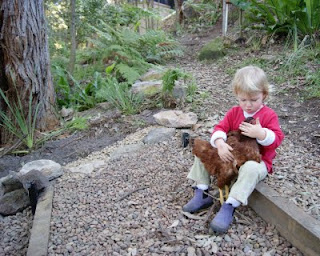 Isla takes some time out with ruby o the new steps - I carted down a metre and a half of gravel in little 8 litre buckets last Tuesday - it was a good workout foe my calves and hands. But the gravel works well to give a great dry section some grip where was once a damp watercourse. I have gone for a dry creek bed look with big sandstone rocks along the edges, buried with concrete to stop the gravel spreading when walked on over time. Love the sound of gravel, it is another layer of experience to hear your footfall scrunch scrunch scrunch as you walk along the path.
 Some images of the chicken catching team. Have realised that it is far easier to time the return of the birds to the coop than to try and get them in whilst it is still broad daylight. On dusk the birds are orderly and calm and trot in a line to their perches, all I have to do is close the door and screw the latches.
 This beautiful winter weather has been a great chance to steal some time building sandcastles at the beach, and feel the sand between our toes.


I have deliberately tried not to have a designated feed area as it becomes bare, hard and muddy and is not good for growing anything. By moving the feed site around I can target weed spots and put the feed there and after a few days of scratch and peck the weeds are cleared and we are ready to move onto the next feed site.


Subscribe to:
Posts (Atom)
